Search for a wood-and-glass nebulizing diffuser and you will find plenty of pages explaining what it does — waterless, heat-free, zero plastic contact. Very few explain how it is made. That is a gap worth closing, because almost every problem that shows up in the field — a base that cracks in a dry warehouse, a mist that fades after three months, a glass reservoir that no longer seats properly — was decided long before the unit reached a shelf. It was decided on the workshop floor.
This article walks through the seven production stages behind a solid wood and borosilicate glass two-fluid nebulizing diffuser, and flags the checkpoints that matter when you source a private-label run. If you remember one thing, make it this: in a waterless atomizer there is no water to hide behind. Every tolerance and every seal is exposed to undiluted essential oil from the first drop.
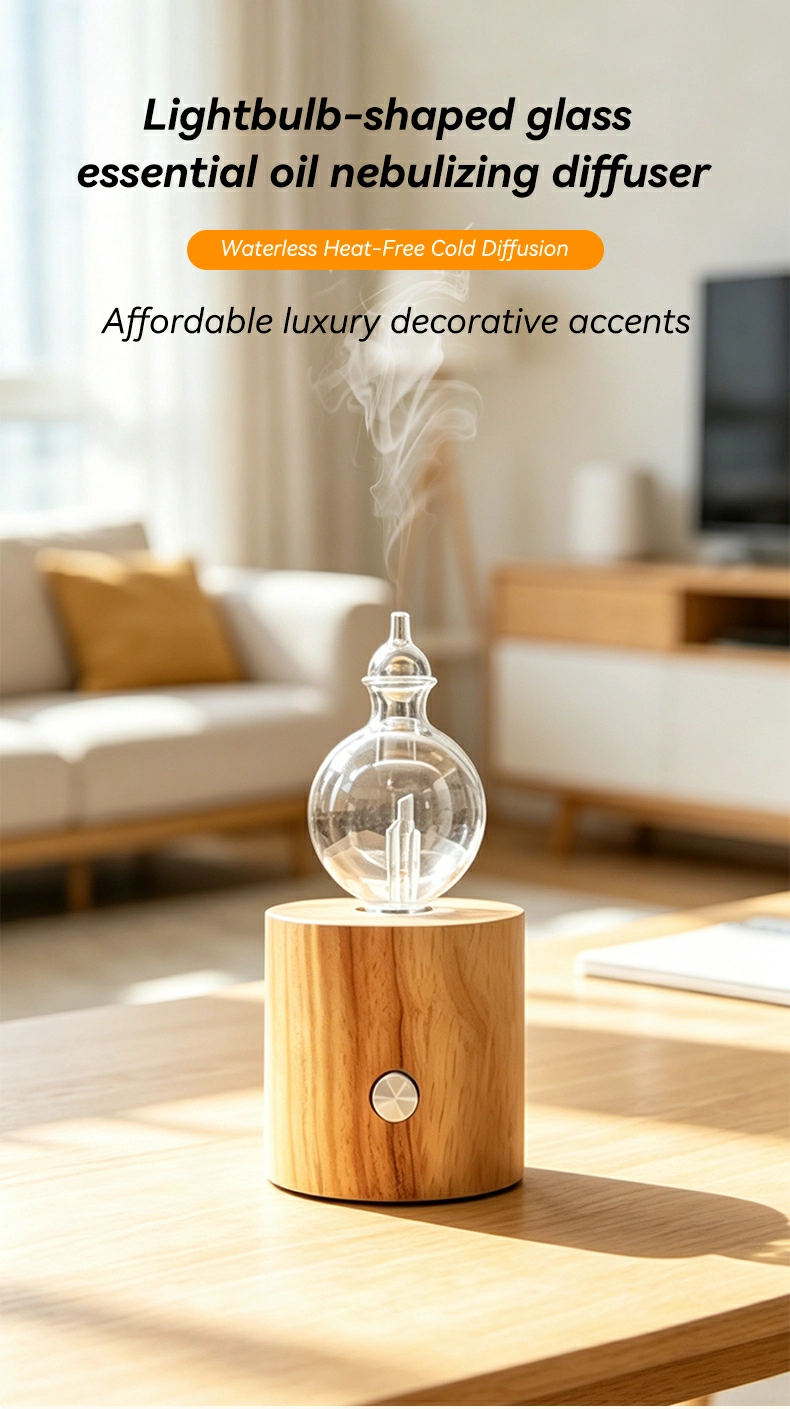
The finished article: a solid wood cylinder base paired with a hand-blown bulb-shaped borosilicate reservoir. Everything below is what it takes to get here consistently.
A nebulizing diffuser is a small air compressor wearing a wooden jacket. Compressed air passes a narrow orifice and tears the oil into a dry mist through the Venturi effect — typically 0.5–3 µm, fine enough to hang in the air without wetting a tabletop. That physical job dictates the design before anyone touches a piece of timber.
Three decisions here govern everything downstream. Nozzle geometry: the orifice, air channel and oil feed tube must be concentric, because a fraction of a millimetre off-centre gives a sputtering plume instead of a clean column. The glass-to-wood interface: the reservoir seats into machined wood, which must hold it firmly without preventing expansion. Thermal planning: the pump's modest heat has to dissipate through the body rather than warm the oil.
Solid wood is a living material with a memory. Before a block goes near a CNC machine it is kiln-dried to a stable moisture content and rested, because timber machined wet will move afterwards — and a base that moves either cracks along the grain or opens a gap around the glass seat. Walnut, beech and teak behave differently; the denser and oilier the species, the slower the drying schedule it needs.
Machining is simple in principle and unforgiving in practice. The cylinder is turned, the pump cavity bored, the glass seat cut, the cable exit drilled at an angle that will not create a stress point. Grain direction is checked against the cut, since a base cut across a knot fails in transit rather than on the bench. Sanding then runs through progressively finer grits, followed by a food-grade natural wax finish — no paint, no glue veneer, no formaldehyde-bearing lacquer, because the wood sits centimetres from an open oil reservoir all day.

Boring the pump cavity and glass seat. This tolerance decides whether the finished unit wobbles or holds the reservoir dead centre.
The reservoir is where the oil lives, so it is the one part that cannot be compromised. Borosilicate is chosen for inertness — it will not react with acidic citrus oils, will not absorb scent, and will not cloud the way softer glass does after repeated cleaning. In a two-fluid system the glass also forms part of the atomization chamber, so its internal geometry is functional rather than decorative.
Each reservoir is lampworked by hand over a torch: bulb formed, neck drawn, oil feed positioned, orifice end finished. Two qualities separate a good piece from a reject. Wall consistency — uneven walls distort light and create a weak point that may fail on a cold night or a warm pallet. Annealing — the piece is slowly cooled to relieve internal stress; skip it and a hairline crack can appear at the neck weeks later.
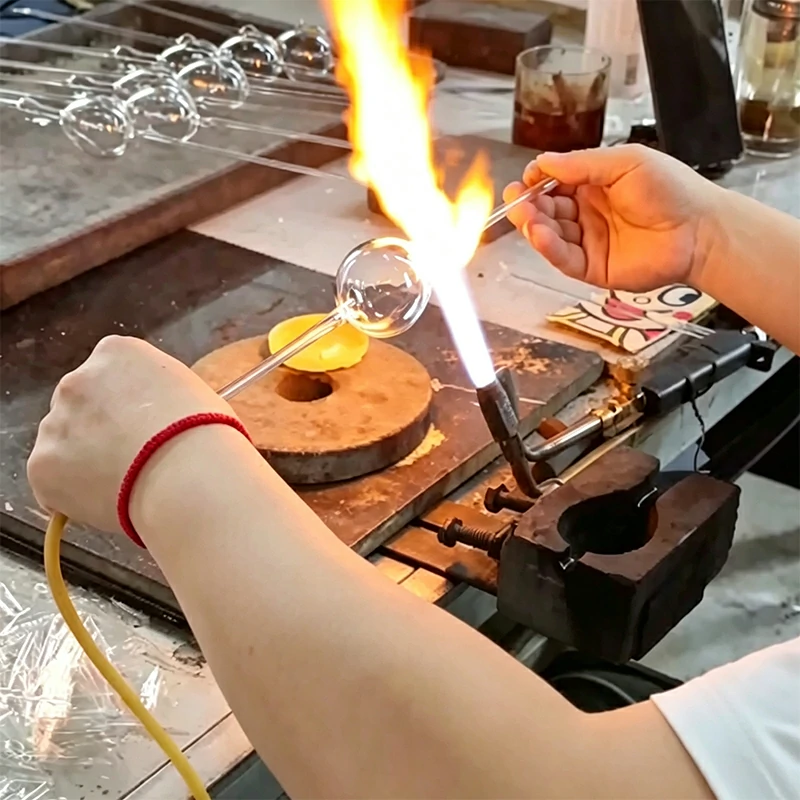
Lampworking a reservoir. Hand-blown glass is why no two units are identical — and why annealing discipline matters more than speed.
Assembly is where the two crafts meet, and the stage most likely to be rushed. The nozzle assembly is seated and checked for concentricity. The air path is sealed and pressure-tested, because a slow leak produces a diffuser that works beautifully for ten minutes and then fades. The pump is mounted on damping pads, the PCB fixed, the knob or touch sensor aligned, and the warm LED positioned so light reads through the glass instead of glaring off it.
Every unit is then wet-tested with actual oil rather than water. Water will not reveal a partly blocked feed tube, and it will not expose a coarse or spitting mist. A unit that passes shows a steady plume at low setting, a clean cut-off at the knob's minimum, and no oil creep around the seat after a full cycle.
Small air pumps share a characteristic failure curve: a few fail early, most run for years, and the early failures cluster in the first hours of operation. That is why burn-in exists. Units run continuously for a set period, then are re-checked for mist output, noise, LED function and knob response. It is also where you catch faults no incoming inspection finds — a pump two decibels louder than its neighbours, a nozzle that atomizes well cold and poorly warm, a wooden base that ticks as it dries. Skipping the step does not remove the failures; it relocates them to your customer's return desk.
A diffuser that survives the factory and dies in a courier van is a total loss, and glass-and-wood is the least forgiving combination to ship. Packaging is engineered around two weak points: the glass neck and the base's corners. Moulded pulp or formed EVA holds the unit away from the carton walls, the reservoir gets its own cradle so it cannot lever against the base, and the pack is drop-tested rather than assumed. For private label, the box is also often the only branding the end customer keeps, so print, finish and insert layout are approved here — not after the run starts.
The last stage is paperwork as much as pallets: inspection records, test data, material declarations, spare parts and a packing list that lets a distributor receive a shipment without opening every carton. It is unglamorous, and it is the difference between a supplier and a partner when a container is held or a retailer asks for documentation six months later.
If you are commissioning a wood-and-glass nebulizer, the brief that gets a clean result covers:
Vague briefs do not fail loudly. They fail quietly, in a second sample round three months later, when the glass and the wood have each been optimised separately and no longer fit.
IdealAppl has spent 16 years building solid wood and glass two-fluid nebulizing diffusers and the oils that go into them, across an 8,000 m² facility producing 220,000 pieces a month, with 103+ patents and 100% burn-in testing before shipment. Every unit pairs hand-polished natural solid wood with food-grade borosilicate glass, so the oil stays pure from the first drop to the last breath of mist. Explore the solid wood bulb-shape nebulizing diffuser, the walnut bird-shape model, or the full waterless scent diffuser range. OEM and ODM samples start in seven days.
Why is borosilicate glass used instead of ordinary glass?
It resists thermal shock and chemical attack from acidic oils, and it does not absorb scent the way softer glass and plastic do — so no cross-contamination when you switch oils, and no clouding over time.
How can I tell whether a wooden base is really solid wood?
Look at the end grain and at grain continuity around the machined edge. Veneer shows a repeating pattern and a seam line; solid wood shows grain that changes direction as the surface turns. Weight and the sound when tapped also differ.
What does burn-in testing actually catch?
Early pump failures, nozzles that atomize poorly once warm, noisy units and slow air leaks — the defects that pass a quick functional check and then fail in a customer's home within weeks.
Can the glass reservoir be replaced on its own?
On most of our models, yes. The reservoir seats into the wood base rather than being bonded to it, which keeps the unit serviceable. Ask for the spare-part list when you specify an order.
Related reading: The Science of Two-Fluid Cold Atomization · Solid Wood Diffuser Advantages · How to Clean and Maintain Your Wood & Glass Nebulizing Diffuser
 EN