Almost every question we receive about a nebulizing diffuser eventually turns into an oil question: which oil should I use, why does this one smell weak, why did the mist stop after a month. The honest answer rarely starts with the scent. It starts with what is actually in the bottle — because a waterless two-fluid atomizer does not dilute, filter or forgive. It pushes whatever you give it through a narrow glass orifice at pressure, and the physical properties of that liquid decide whether you get a clean plume or a blocked nozzle.
This guide separates true essential oils from fragrance (aroma) oils, explains how each behaves in cold-air atomization, and gives buyers a checklist for verifying quality before a private-label order.
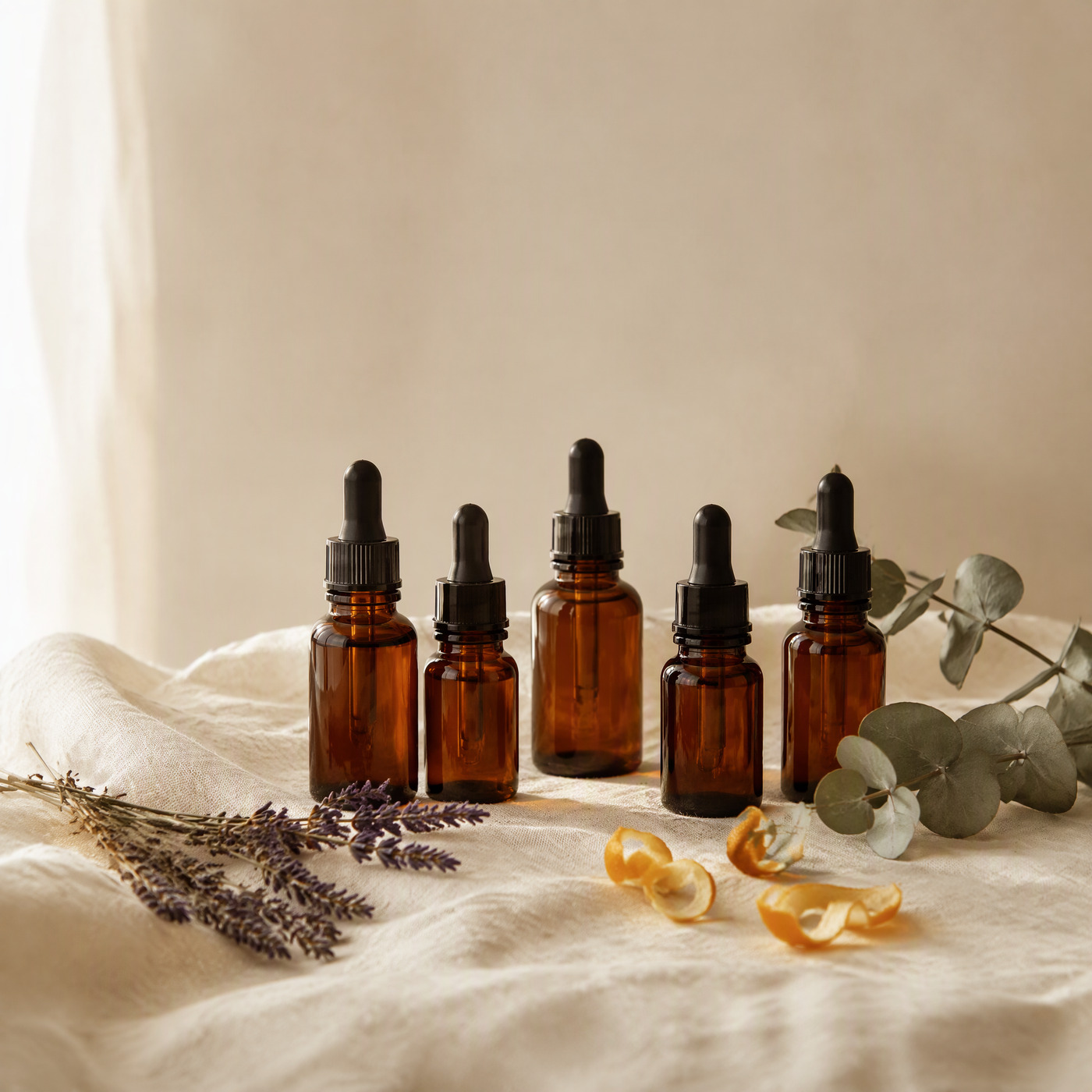
Amber glass, tight closures and a batch number on the carton matter more than the label artwork — especially when the oil will be atomized undiluted.
Essential oils are extracted from plant material — usually by steam distillation or, for citrus, by cold pressing the peel. They are complex mixtures of dozens of aromatic molecules, and their scent is inseparable from their chemistry: the same lavender from a different altitude or harvest year will smell and behave slightly differently. Fragrance oils (also sold as aroma oils or perfume oils) are formulated blends of natural and synthetic aroma compounds, usually carried in a solvent, built to deliver a consistent, repeatable scent at a controlled cost.
Neither is “better” in the abstract. They serve different jobs. The problem starts when one is sold as the other, or when either is formulated for a different device — a candle, a soap, an ultrasonic tank — and then poured into a nebulizer.
Two-fluid atomization works on air pressure, not heat or vibration. Compressed air accelerates past an orifice and tears the liquid into droplets in the 0.5–3 µm range. Three properties decide the outcome:
This is also why an oil that performs beautifully in an ultrasonic diffuser can disappoint in a nebulizer. In an ultrasonic tank the oil floats on water and is pushed out by vibration; the water does the volume work. In a nebulizer, the oil is the entire payload.
|
Oil family |
Typical examples |
Behaviour in a nebulizer |
How to run it |
|
Steam-distilled essential oils |
Lavender, peppermint, eucalyptus, tea tree, rosemary |
Clean, consistent atomization; the most predictable group overall |
Default setting; 3–5 drops per session |
|
Cold-pressed citrus |
Lemon, sweet orange, bergamot, grapefruit |
Very thin and fast; strong initial throw, short persistence |
Low to medium setting; blend with a woody base to hold the scent |
|
Absolutes, resinoids, CO2 extracts |
Vanilla absolute, benzoin, oakmoss, frankincense resin |
Thick and slow; prone to gummy build-up at the feed tube |
Blend at 20–30% with a thinner oil; clean the glass more often |
|
Fragrance (aroma) oils |
Branded scent libraries, hotel and retail programmes |
Consistent and cost-stable; performance depends entirely on the carrier |
Ask for the carrier spec and a device-compatibility test before committing |
|
Carrier-diluted blends |
Massage and skincare blends in jojoba or sweet almond |
Will not atomize; leaves an oily film and blocks the nozzle |
Never use in a waterless nebulizer |
In our service data, nozzle problems trace back to the same short list almost every time:
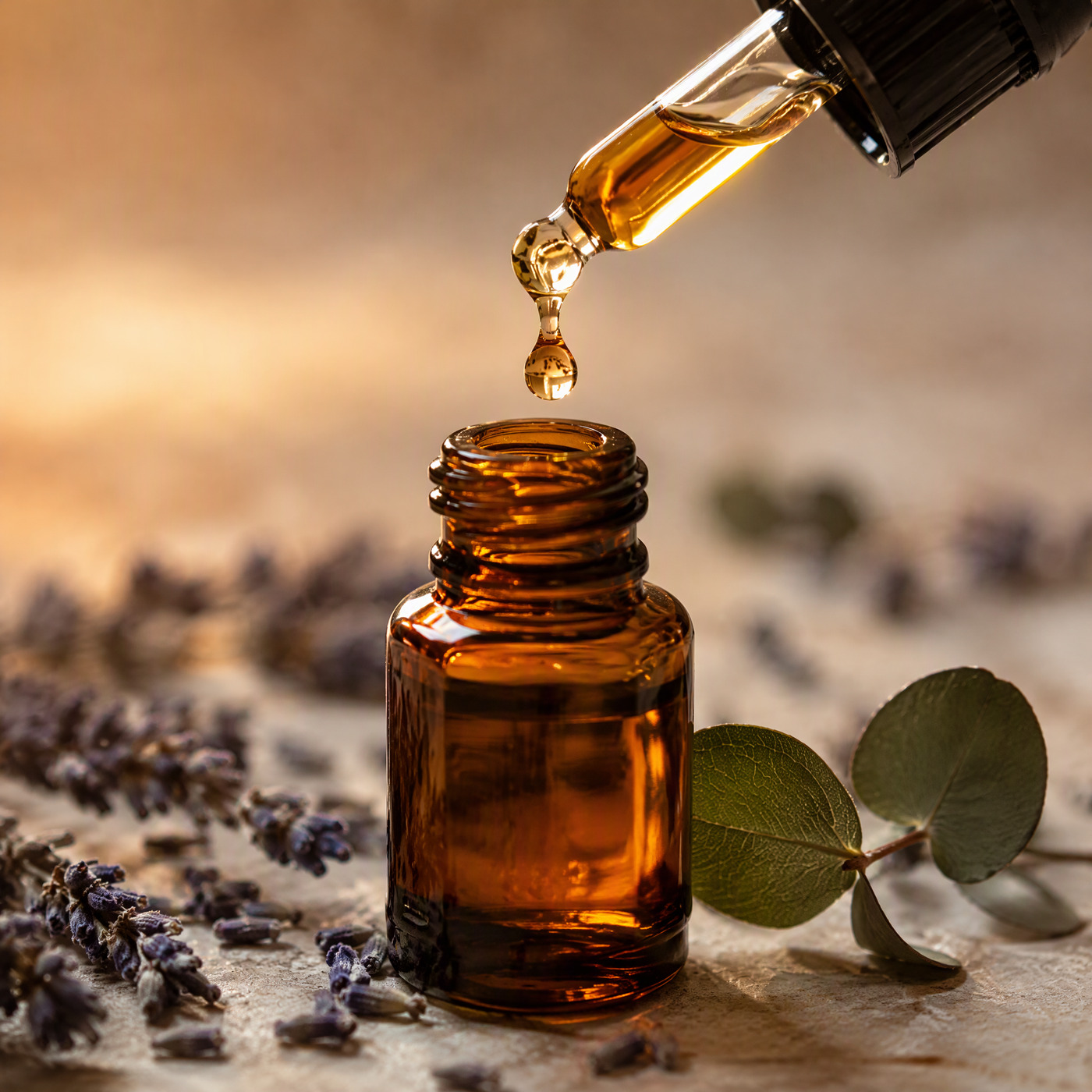
Scent families are usually chosen for the mood they create. In a nebulizer, the second question has to be how the oil flows.
Whether you are buying for a hotel programme or a retail line, these are the documents and parameters that separate a stable supply from a lucky first shipment:
Nebulizer blends are built in drops, not percentages of a carrier. Two working rules cover most cases:
Balance top and base. A 3:2 ratio of light to heavy oils gives a scent that opens quickly and still holds an hour later — for example three drops of sweet orange to two of cedarwood, or three of lavender to two of frankincense.
Cap the heavy fraction. Keep viscous absolutes and resinoids at roughly a quarter of the blend. Above that, performance drops before the scent improves, and the glass needs cleaning far more often.
Practical habit: switch oils only after wiping the reservoir, and run a plain, thin oil for a few minutes after a heavy blend to flush the feed tube.
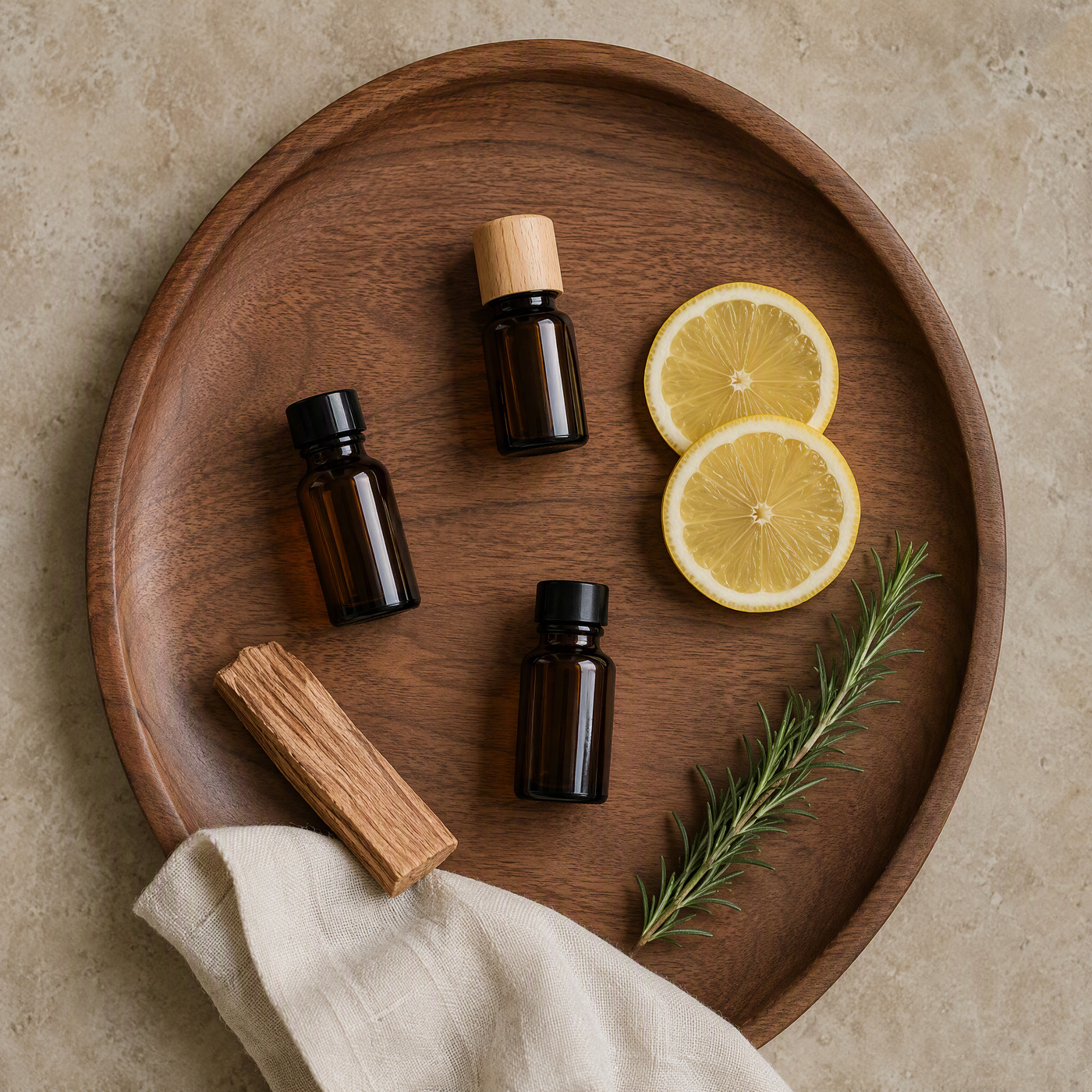
A blending tray in practice: citrus for lift, cedar for hold. The ratio matters more than the number of bottles.
Essential oils degrade with light, heat and oxygen. Keep them in dark glass, tightly capped, in a cool cupboard rather than on a sunny shelf, and expect citrus to fade faster than resins. A bottle that has thickened or turned sharp and sour is not a bargain — oxidized oil is one of the most common causes of a blocked nozzle that gets blamed on the diffuser.
If you are building a scent line to sit alongside a diffuser, three decisions shape the programme. Source oil and hardware together where possible, so atomization is validated on the real device. Fix the specification in writing — a GC-MS reference standard, not a smell test on a paper strip. And decide early whether the line is essential oil or fragrance oil, because the claims, labelling and documentation obligations differ substantially.
IdealAppl builds both halves of the aroma equation: solid wood and glass two-fluid nebulizing diffusers, and the plant-derived fragrance and essential oil range that runs in them. With 16 years of manufacturing, an 8,000 m² facility, 103+ patents and 100% burn-in testing, every diffuser is validated against the oils it will actually carry — so the scent you approve in the sample room is the scent your customer receives. Browse the essential oil and aroma oil range or the waterless nebulizing diffuser collection.
Usually yes, provided the fragrance is formulated without water, glycerin or heavy fixatives and has been tested in the device. Ask for the carrier specification and run a 30-day compatibility test before committing to a production run.
The most common causes are a partially blocked feed tube from a viscous or oxidized oil, or a slow air leak at a seal. Clean the glass and feed path first; if the problem returns immediately, have the air path pressure-checked.
Not in a nebulizer — waterless atomization is designed for undiluted oil. Dilution is only relevant for ultrasonic diffusers and for skin application.
Typically 12–24 months for citrus and other top notes, longer for resins and woods, stored in dark glass away from heat. Judge by smell and flow rather than the printed date alone.
Mild oils such as lavender and chamomile, diffused briefly on a low setting in a ventilated room. Avoid tea tree, eucalyptus and citrus around cats, and see our dedicated guide for the full picture.
Related reading: 10 Common Single Essential Oils: Benefits & Blending Guide · Best Essential Oils for Sleep · Are Nebulizing Diffusers Safe for Pets and Kids?
 EN